Otto Werner · 26 September 2026
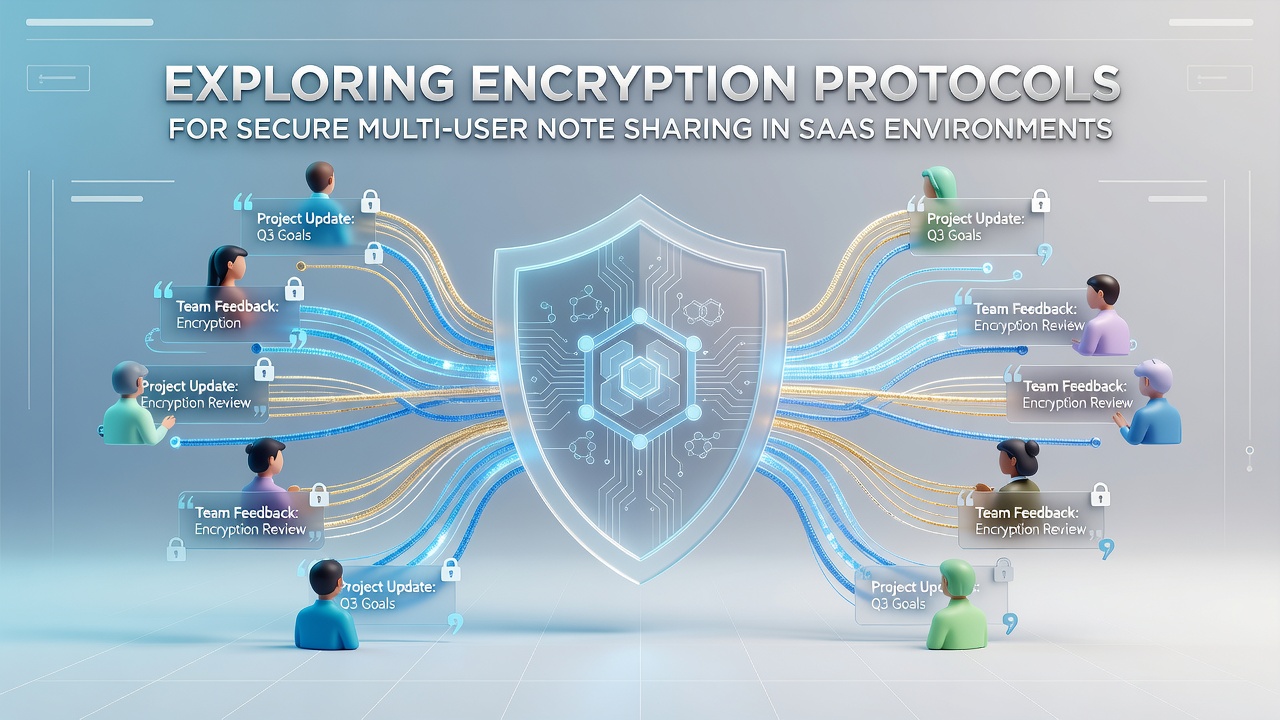
Exploring Encryption Protocols for Secure Multi-User Note Sharing in SaaS Environments
Secure note sharing within SaaS platforms requires encryption protocols that protect data both in transit and at rest while supporting collaborative access among multiple users. These systems handle sensitive information ranging from project plans to personal records, and they rely on established cryptographic standards to maintain confidentiality and integrity across distributed environments. Research from government agencies such as the National Institute of Standards and Technology shows that symmetric algorithms like AES-256 combined with asymmetric methods provide the foundation for most enterprise-grade solutions.
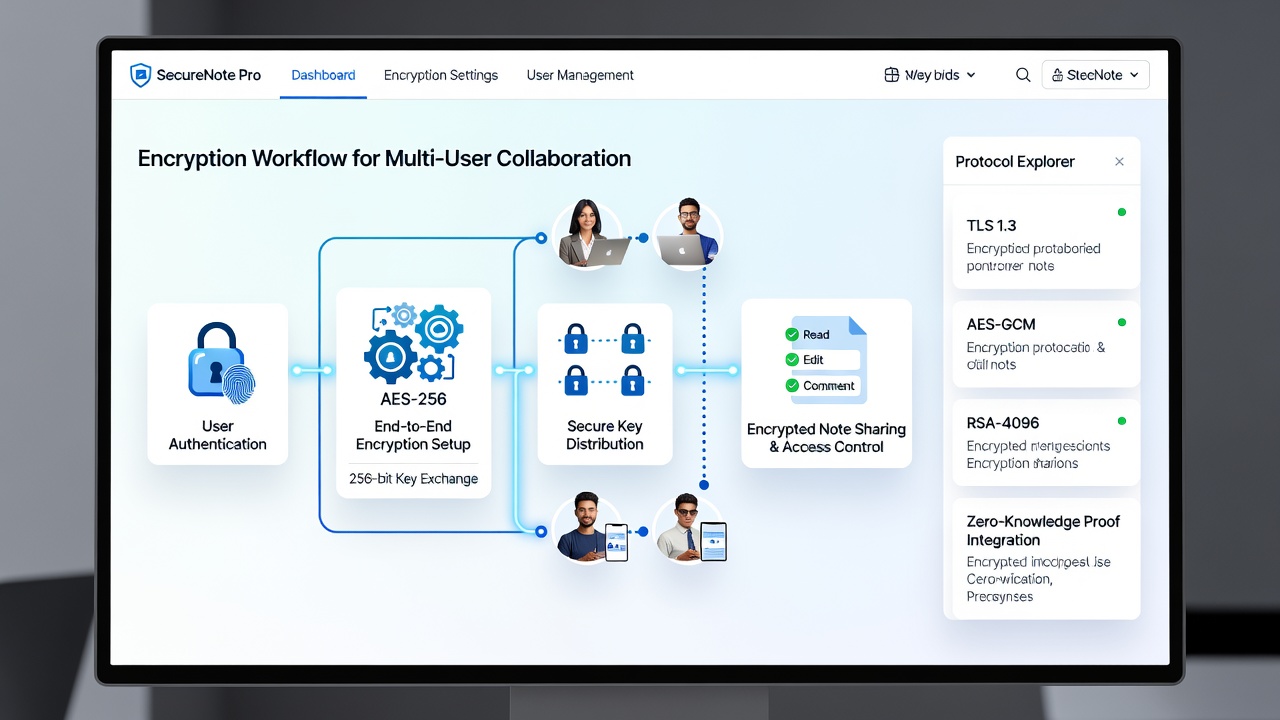
Multi-user scenarios introduce additional layers of complexity because each participant needs access without exposing keys or allowing unauthorized reads. Platforms achieve this through techniques such as client-side encryption followed by secure key distribution mechanisms. Observers note that end-to-end encryption models keep the service provider from viewing plaintext content, whereas server-side approaches place trust in the provider's infrastructure controls.
Core Encryption Standards in Use
Industry reports indicate that AES remains the dominant symmetric cipher due to its balance of speed and security, with 256-bit keys serving as the current benchmark for high-security deployments. Public-key systems including RSA and elliptic curve cryptography handle initial key exchanges and digital signatures. Data from academic studies reveal that elliptic curve variants offer equivalent strength with smaller key sizes, which reduces computational overhead in mobile and web-based SaaS clients.
Key management services often integrate hardware security modules to store and rotate master keys. These modules prevent direct exposure during operations, and they support audit logging required by compliance frameworks. Experts have observed that rotating keys on a scheduled basis limits the window of exposure if any single key becomes compromised.
Handling Multi-User Access Controls
Secure sharing workflows depend on fine-grained permission systems that encrypt data per user or per group. One common pattern involves generating a content encryption key for each note, then wrapping that key with the public keys of authorized collaborators. This approach allows revocation by simply removing a user's wrapped key without re-encrypting the entire document.
Zero-knowledge architectures take the model further by ensuring the SaaS provider never holds decryptable copies. Users authenticate through cryptographic challenges rather than shared passwords, and session tokens carry limited scope. Studies from research institutions have documented that such designs reduce insider threat surfaces while increasing the importance of strong client-side key storage practices.
Performance and Usability Considerations
Encryption introduces measurable latency during note creation, editing, and synchronization across devices. Benchmarks published by standards bodies demonstrate that optimized AES implementations on modern processors complete bulk operations in milliseconds, yet key derivation and signature verification steps can still add perceptible delays in collaborative sessions. Developers therefore combine hardware acceleration with efficient protocol choices such as ChaCha20-Poly1305 for environments lacking dedicated cryptographic hardware.
Usability studies show that transparent encryption succeeds when users do not need to manage keys manually. Automatic key escrow options or recovery codes help prevent permanent data loss, while maintaining the principle that the provider cannot access content. Organizations adopting these systems report higher adoption rates when interfaces hide cryptographic details behind familiar sharing dialogs.
Regulatory and Compliance Landscape
Multiple jurisdictions impose requirements on data protection that directly influence protocol selection. The European Union's data protection regulations emphasize encryption as a technical safeguard, and similar guidance appears in Canadian and Australian cybersecurity frameworks. Service providers must demonstrate that chosen algorithms meet current strength recommendations and that key management processes undergo regular independent audits.
September 2026 is expected to bring updated guidance from several standards organizations on post-quantum cryptography migration paths. Organizations preparing for these changes have begun testing hybrid schemes that combine classical and quantum-resistant algorithms to protect long-lived notes against future threats.
Emerging Approaches and Integration Patterns
Developers increasingly combine traditional encryption with secure multi-party computation techniques for scenarios where partial computations on encrypted data become necessary. These methods allow aggregate analytics without decrypting individual notes, though they remain computationally intensive for widespread SaaS deployment. Research indicates steady progress in practical implementations that could reach production environments within the next few years.
Integration with identity providers enables federated access while preserving encryption boundaries. Single sign-on tokens map to cryptographic identities, and attribute-based encryption schemes grant access based on role or department attributes rather than explicit user lists. Such patterns reduce administrative overhead in large organizations that manage thousands of shared notes.
Conclusion
Encryption protocols for multi-user note sharing in SaaS environments rest on well-established symmetric and asymmetric primitives, augmented by sophisticated key management and access control layers. Continued evolution in standards and hardware support will shape how platforms balance security, performance, and collaboration features. Organizations evaluating these systems benefit from reviewing current implementation details against published benchmarks from recognized standards bodies and research sources.